Slopes and Infrastructure
Roads, railways, bridges, building sites, landslides and degraded land
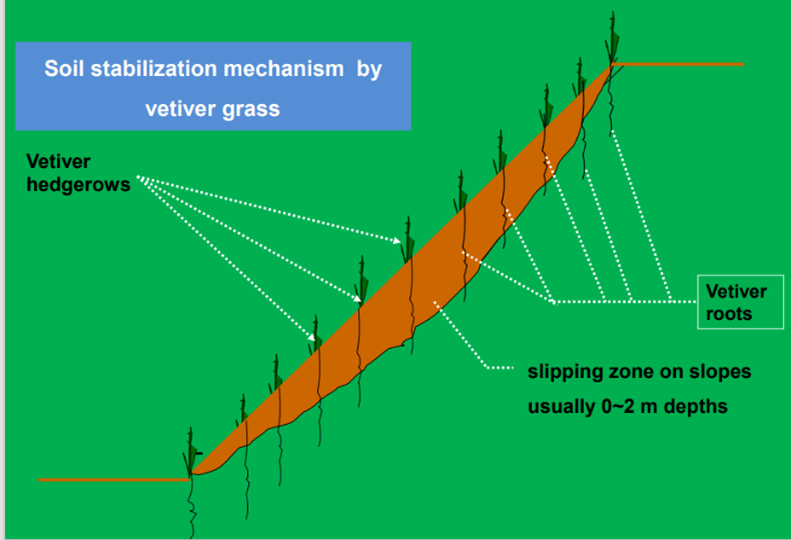
Bare earth slopes on roads, railways and building sites are among the worst sources of erosion. They silt up rivers, fail in heavy rain, and cost lives and money. Vetiver protects them at low cost in two ways. Its roots reinforce the soil in the rooted zone, about 2 m deep, and the plant draws water out of the slope, lowering the water pressure in the soil that sets off slips. Above ground, the hedges filter runoff, so cleaner water leaves the site.
Vetiver is also a pioneer plant: native plants often establish in its shelter and, in time, may take over.
- Highways
- Rural and farm roads
- Railways
- Utility rights-of-way
- Bridges and culverts
- Building sites
- Landslide repair
- Land rehabilitation and gullies
- Further reading
Highways
Over the past 30 years, vetiver has become an established bioengineering tool for highways in the tropics, where cut and fill slopes face very heavy rain. Many companies in Latin America, Africa and Asia now offer vetiver services.
On Vietnam’s 2,000 km Ho Chi Minh Highway, vetiver protected cut slopes steeper than 60% under 2,000 mm of rain a year and typhoons, at far lower cost than hard engineering and with little maintenance. Some deep slips, about 10 m deep, occurred that vetiver could not prevent, a reminder that good engineering design is essential. Where native plants established, they gradually replaced the vetiver; where they did not, the vetiver kept protecting the slopes. On fragile slopes above high-value structures, soil nailing combined with vetiver has worked well.


Photo essay (PDF)Design guidance: B1 DS-ENGINEERED-SLOPESDesign guidance: B3 GUIDE_SIMPLE-SLOPES
Rural and farm roads
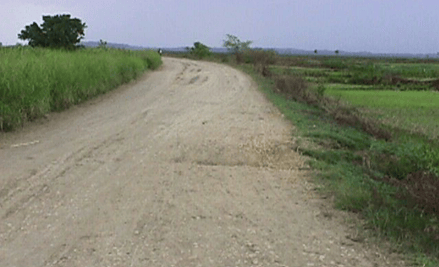
Without rural roads, children cannot get to school, farm produce cannot reach market, and communities are cut off from services. Yet rural roads are usually last in line for maintenance and deteriorate fast. Vetiver along road shoulders stops the shoulder eroding and cutting back into the road surface, and on dangerous bends it marks the edge. Culverts and small bridges can be protected from washouts. Road cut-off drains can lead safely into farm hedgerows, spreading the water onto the land instead of starting roadside gullies.
Railways
Vetiver has stabilized railway embankments and cuttings in China, Madagascar, South Africa, India and Australia. It has succeeded each time, because railway engineers insist on quality work and follow standards. It also recovers quickly after fires, which keeps the embankment protected.
In China, the Xinchang railway company planted 120,000 vetiver slips on a difficult sand-fill embankment. The vetiver was effective within two months, and 14 years later it was still there, with native plants colonizing the bank. Poor farmers from the Dabie Mountains supplied the planting material, and local farmers now cut the grass for their own use, which provides the maintenance. In Madagascar, vetiver saved the FCE railway from the cyclone damage that used to close it for months each year.

Utility rights-of-way
Pipeline, power line and other utility rights-of-way erode badly if they are not protected, and they often run through remote country. They need passive protection that needs little maintenance and survives fire. Vetiver has done this in Thailand, Costa Rica, Madagascar and Venezuela. It also protects the footings of structures such as electricity pylons and pipeline pumping stations.

Bridges and culverts
Where soil meets concrete and water, at bridge abutments, culverts and other structures on rivers, drains and canals, the soil is the weak point unless it is protected. Vetiver’s deep roots bind and reinforce the soil, its stiff stems slow the current, and its tops bend over in strong flows and absorb the water’s energy.
In Kenya, river erosion put a new community suspension bridge across the Nzoia River at risk in 2018. The bank was stabilized with vetiver in 2019 and the bridge footing is now considered secure. At the Doria Bridge in Assam, India, vetiver stabilized the approach, and within two years native plants were establishing alongside it.


Building sites
Vetiver has been used since the 1990s to stabilize new and existing residential and industrial sites. In 1996, Tony Tantum planted vetiver on the bare, fast-eroding land of the Mahogany Ridge industrial park in KwaZulu-Natal, South Africa, before any building had started. Today the site is stable, and native plants have taken over most of the vetiver. In Costa Rica, steep resort and industrial sites have been stabilized extensively with vetiver. As extreme rainfall increases, slopes above and below houses fail more often, and vetiver is an effective, low-cost remedy.


Landslide repair
Vetiver has mostly been used to repair landslides rather than to prevent them on natural slopes. Repairs have worked in Brazil (Itaipava–Petrópolis, after a 2008 landslide), in Panama (Landis Reserve) and in Australia, with geotextiles or with hard structures. On road construction sites, it has prevented many slips on shallow cut and fill slopes.
Repair starts with drainage. Guide B2 covers shallow slips, 2 m deep or less and up to 500 m², that have had no fresh movement for one full wet season. Anything larger, deeper or still moving needs an engineer and B1.


Design guidance: B2 GUIDE- LANDSLIP REPAIRDesign guidance: B1 DS-ENGINEERED-SLOPES
Land rehabilitation and gullies
Vetiver is an excellent “fix-it” plant for degraded land. It survives extreme soils and rainfall, tolerates fire, grazing and toxic soils, and stays where it is planted. On bare land where trees fail for lack of moisture and nutrients, vetiver hedges create a moister microclimate that lets native plants and trees establish.
Hedges across gully floors, often helped by earth bags at first, stop gullies cutting back and trap sediment. Examples include urban ravines in Brazzaville and Kinshasa in the Congos (Alain Ndona), a degraded pineapple farm in Thailand, the “red desert” of Guangdong, China, and abandoned tin mines in Sumatra, Indonesia.


Photo essay (PDF)Design guidance: A6 GULLY REHABILITATIONMine sites
Further reading
Handbooks, photo essays, presentations and case studies on vetiver for slopes and infrastructure. Type in the search box to filter by topic, country or author. More papers are in the Document Center and the Conference Papers.