|
|
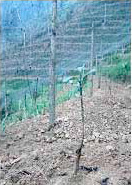
Soil Erosion has been a major issue in the past and will become an even greater issue in the future as population growth continues to expand and land resources are more intensively used, often to a point of destruction, and the accelerating impact of climate change and the related extreme weather events. Increased soil erosion means loss of land, reduced soil fertility, greater rainfall runoff, lower groundwater recharge, more sediment flows in river, higher contaminants in diminishing water supplies, lowered quality of drinking water, increased flooding, and diminished economic benefits and increased hardships to both rural and urban populations especially in developing countries, but also increasingly in developed countries too. If applied correctly the Vetiver System can be an important tool to reduce erosion (by up to 90%), reduce and conserve rainfall runoff (by as much as 70%), improve ground water recharge, remove pollutants from water, reduce the risk of flooding, and improve economic benefits to communities. Soil Erosion - A Hidden Catastrophe Not Far Away!-- David Pimentel and Michael Burgess (both of Cornell University) have published a paper "Soil Erosion Threatens Food Production" that everybody who works in the agricultural and natural resources sectors should read. An abstract of their paper follows: "Since humans worldwide obtain more than 99.7% of their food (calories) from the land and less than 0.3% from the oceans and aquatic ecosystems, preserving cropland and maintaining soil fertility should be of the highest importance to human welfare. Soil erosion is one of the most serious threats facing world food production. Each year about 10 million ha of cropland are lost due to soil erosion, thus reducing the cropland available for world food production. The loss of cropland is a serious problem because the World Health Organization and the Food and Agricultural Organization report that two-thirds of the world population is malnourished. Overall, soil is being lost from agricultural areas 10 to 40 times faster than the rate of soil formation imperiling humanity’s food security". A young Ethiopian graduate, Tekalign Negash Terefe, carried out a study, "Farmers’ Perception on the Role of Vetiver Grass in Soil and Water Conservation in South Western Ethiopia:-The Case of Tulube Peasant Association; Metu District" of a farmers' association that used vetiver for soil and water conservation. The study, although not large, arrived at some interesting findings and insights. Part of the abstract reads "This study identified that Vetiver grass is the cheapest and easily handled by farmers of the area. The assessment of farmers’ perception on Vetiver grass and its use for soil and water conservation showed that most of the farmers got awareness by the NGOs. But illiteracy, land size and ownership problems hinder the further expansion of vetiver grass to the area. This study also identified that Vetiver grass is a very simple, practical, inexpensive, low maintenance and very effective means of soil and water conservation, sediment control, land stabilizations and rehabilitation. Farmers who planted vetiver grass on their farm land have been benefited both in land management and as a source of income which improved has their socio economic status in the community". Vetiver grass has been used (sometimes unknowingly) for these purposes for centuries in south India. In the last century the grass was taken around the world for use as an aromatic plant (root producing oil of vetiver); in some places such as Fiji, South Africa, and the West Indies it was grown as a hedge for soil conservation purposes. Since 1987 the use of vetiver for the latter purpose (grown as a narrow hedgerow across the slope of the land that slows down rainfall runoff velocity and filters out soil particles) has expanded significantly across the tropical and semi tropical countries of the world. Research and field results are well documented and can be found in the web site archives. |
|
MADAGASCAR - Savonnerie Tropicale Huilerie de Melville (STHM) is the only certified |
|
CONSERVATION MARKETING: For a number of years we have seen an increasing number of small farmers selling vetiver plants as a commodity to other farmers, construction companies, local governments, and to landscapers. As an example, Roley Noffke of Hydromulch, South Africa, has been a major leader in encouraging small farmers to produce quality plant material as a farm commodity for sale to construction companies. See: https://www.vetiver.org/ETH_WORKSHOP_09/ETH_CD2.pdf Recently Tessema Awoke wrote a paper titled - Conservation Marketing: The Case of Vetiver Grass Technology (VGT) in Illu Aba Bora Zone. of Ethiopia. He has coined the phrase "Conservation Marketing" which is appropriate for what is being done. Farmers are using excess vetiver plant material from their on farm soil conservation vetiver hedgerows as a cashable commodity for sale to other farmers and non-farm users (construction companies, landscapers, etc). Read more .... |
|
Soil and water conservation achive files Vetiver for Erosion Control presentations:
Compare Vetiver System for on farm soil and water conservation with engineered structures. VETIVER INSTALLATION GUIDE. This guide was prepared by Oahu Resource Conservation and Development Council in cooperation with USDA Natural Resource Conservation Service (NRCS) Pacific Islands Area with support from an NRCS Conservation Innovation Grant (November 2012). It is an excellent guide particularly for soil conservation applications. Recommended reading
|
|
Comparing Vetiver System with engineered soil conservation |
This fact sheet prepared by Elise Pinners. compares the differe outnces in design and function between Vetiver Hedgerows and constructed terraces. recommended as an informational hand out hand |
O CULTIVO DO VETIVER CHRYSOPOGON ZIZANIOIDES (L.) ROBERTY PARA A ESTABILIZAÇÃO DO SOLO E O CONTROLE DA EROSÃO. |
Portuguese text and images from Paulo Rogerio - Brazil |
Multiple Benefits of the Vetiver System and its Environmental Application in Ethiopia |
A thoughtful and interesting paper by HABTEMARIAM ABATE AND BELAY SIMANE on the growing application of the Vetiver System in Ethiopia for environmental improvement. |
New Zealand Vetiver |
Paul Truong visits New Zealand and meets John Greenfield and Wendy Hamilton Gates. His visit notes and photos shows that VS does a pretty good job in the North Island |
|
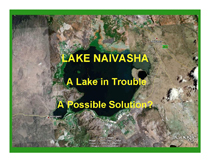
Lake Naivasha, an important Great Rift Valley Lake in Kenya is in trouble. It is polluted by silt, agrochemicals, and urban effluent. Unless a solution is found the Lake will die. All the land and water problems within its large catchment area show up in the lake: waste water from Naivasha town, agro chemicals from nearby intensive export crop businesses, and soil erosion throughout its 2,500 sq km watershed attributed to small scale and very intensive unprotected farming. Community and technical solutions are required to avert disaster. The Vetiver System can provide part of the solution in all the problems areas. For more see |
|
Vetiver System Application - Technical Reference Manual - in English, French, Italian, Indonesian, Mandarin, Persian, Portuguese, Spanish, Swahili, Vietnamese, and can be downloaded FREE. They can also be purchased from Amazon.com |
Vetiver System for Soil and Water Conservation |
Powerpoint: Watershed Restoration by Using Vetiver Grass Systems (VGS) for Downstream Water Quality Improvement in Southern Guam. By Mohammad H. Golabi Associate Professor of Soil and Environmental Sciences; Clancy Iyekar Graduate Student, College of Natural and Applied Sciences, University of Guam; |
|
Kenya National Vetiver System Workshop - Summary. Picture to left: participants lining up for Vetiver slips! |
|
Ethiopia workshop proceedings index with links to powerpoints and abstracts |
|
|
|
Vetiver System: Ethiopia - Soil and Water Conservation. (movie) |
|
|
|
Vetiver System: Ethiopia - Ground Water Recharge - Ano Farm (movie) |
|
Vetiver System: Ethiopia - Wetland Restoration - Wichi Wetland. (movie) |
VETIVER SYSTEM BIO FUEL |
Vetiver Grass - A new potential energy plant in Saxony - Anhalt. R.Hommel et al. This is an interesting paper relating to growing vetiver in Germany and its potential as a fuel source for bio gas methane production. (Proceedings of Narossa 2008, 14th International conference for renewable resources and plant biotechnology. June 2008, Magdeburg, Germany) Learn more... |
|
The Vetiver System - "key technology" for East Bali Poverty Project in Indonesia. VIDEO This video, produced by Sarah Matthews of Saffyshine Production as part of a Brock Initiative and the East Bali Poverty Project, is a training video that shows how the Vetiver System is a vital component of the East Bali Poverty Project and how it has had an impact on children and their families. The video (32 mins) includes animations, film and narration by people intimately connected to the project. The narration is in Indonesian with English subtitles. Learn more about the East Bali Poverty Project at project website and at TVNI gallery. |
|
Vetiver Grass - The Hedge Against Erosion - A technology for soil and water conservation and embankment stabilization -- VIDEO |
|
Best Practices in Natural Resource Management - Multiple Uses of Vetiver Grass -- VIDEO |
|
Land Pays... (an example of best practices in Ethiopia) -- VIDEO |
|
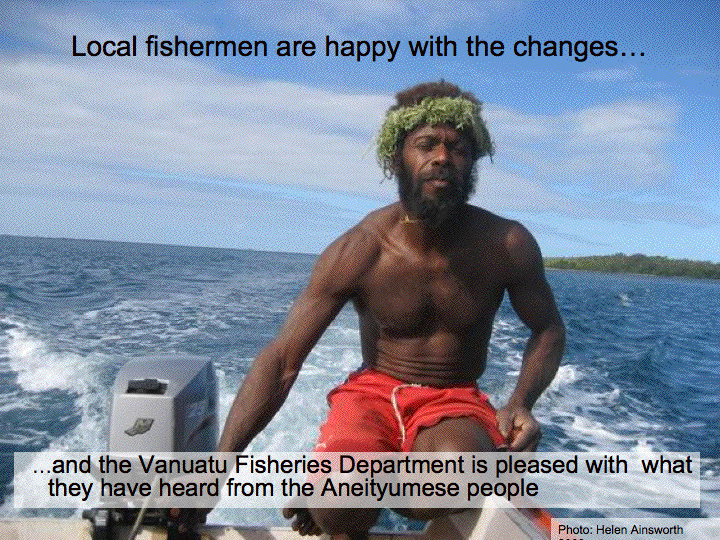
Coral reef protection using VS. Don Miller of New Zealand has been working in Vanuatu (South Pacific island) for some years and demonstrates in this slide show how vetiver hedgerows can be used as an essentail part of reforesting badly eroding landscapes to prevent sediment reaching the sea and destroying coastal coral reefs and fisheries. Don's work can be replicated throughout most island ecologiies where eroding sedimnt flows are effecting coastal habitats in the tropics |
Vetiver for Mali |
COMPTABILITE NATIONALE ET PROJETS ENVIRONNEMENTAUX : CAS DU PROJET VETIVER AU MALI by Claude NJOMGANG & Abdoulaye TRAORE |
|
L’utilization de Vetiver dans l’agriculture et El’arboriculture |
|
KENYA: Mseto Environmental Self Help Group Vetiver Grass Project |
|
VETIVER SYSTEM: THEORY AND PRACTICE |
|
ISLAM, THE ENVIRONMENT AND THE USE OF VETIVER GRASS |
|
Ethiopia workshop summary Summarises the findings of the workshop - endorsed by majority of participants |
|
The Vetiver System for Agriculture: Download the Vetiver System for Agriculture, aomplete handbook on how VS can be used for agriculture. Includes soil erosion control, other agricultural uses, and handicrafts. Hard copies may be purchased from Amazon.com |
|
The Vetiver System for Soil and Water Conservation: Download the Vetiver System for Soil and Water Conservation, a complete handbook on how VS can be used for erosion control. This book is a modification of John Greenfield's "Vetiver Grass - A Hedge Against Erosion" and contains colored images to match the original line drawings that depict detailed application of the technology. Hard copies may be purchased from Amazon.com |
|
Best Practices in Natural Resource Management: Multiple Uses of Vetiver Grass |
|
Rural Poverty Alleviation and Natural Resource Protection in Minority Mountains of Guangxi Province of China: The EED funded Vetiver and Agroforestry Technology for Rural Poverty Alleviation and Natural Resource Protection in Minority Mountains of Guangxi Province of China has been launched. The project aims at helping local farmers develop economic trees for 48700 seedlings and 40 mini-irrigation systems. Meanwhile, vetiver system and agroforestry technology will be introduced and over 3 million vetiver tillers will be planted in order to conserve nature resources and provide farmers with multiple products and materials. Besides, various training courses will be organized and different publications will be produced and widely distributed to extend the project. Learn More |
|
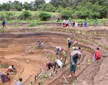
Urban Gully Control and Rehabilitation: In the Democratic Republic of the Congo there are serious social and economic problems caused by large ravines cutting back into urabn areas. A USAID funded community program in the town of Kikwit got the community involved in reshaping the gully and protecting it with vetiver grass, under the leadership of Alain Ndona. See More |
|
Vetiver Activities in North Africa and the Mediterranean: |
Vetiver Grass A Hedge Against Erosion |
John Greenfield's Farmers handbook French Edition |
Economic Analysis |
New Vegetative Approaches To Soil and Moisture Conservation. Magrath, Greenfield and Yudelman |
Disaster Mitigation, Flood and Erosion Control in Haiti |
Short paper by Mike Benge. Senior Agro-Forester |
New Zealand Vetiver |
Paul Truong visits New Zealand and meets John Greenfield and Wendy Hamilton Gates. His visit notes and photos shows that VS does a pretty good job in the North Island |
Vetiver Trials in Dafur |
|
El vetiver como componente del manejo sostenible de los suelos en ecosistemas frágiles de Cuba |
Autores: Claro A. Alfonso, Eduardo A. Cabrera y Pedro Porras. Instituto de Suelos de Cuba. See more... |
Machine Planting of Vetiver in Australia |
Nurseries were planted under Paul Truong's supervision using mechanical planters. See... |
Some Vetiver related works in Ethiopia |
Ethiopia's Sustainable Land Use Forum (SLUF) has been promoting VS in Ethiopia for some years. Here are some photos of its use. See |
LE SYSTÈME VETIVER |
A new handbook for Haitian users - a modification by the WINNER project of "Vetiver Grass - A Hedge Against Erosion" includes photographs. Read more ... |
Vetiver |
This manual was created by the University of the South Pacific to help train people concerned with remediation of sedimentation of coral reefs |
Farm Level Economics of Soil Conservation Practices in The Zomba Rural Development Project of Malawi |
This interesting study by Julius H. Mangisoni covering 450 farmers indicates farmer preference for the Vetiver System. The Net Present Value Model has demonstrated that vetiver bunds are the most profitable and effective methods of combating soil erosion. The effectiveness of the vetiver bunds lies in the fact that they combine two technologies (bare contour bunds and vetiver grass) and the vetiver grass has an excellent rooting system. |
Pilot Demonstration Activity (PDA) in Indonesia |
Applying the Vetiver System For Slope Stabilization and Water Pollution Control |
Kenya - Vetiver - Mseto |
|
Sistema Vetiver(SV) |
Controle da Erosao e Sedimentacao & Estabilizacao de Taludes (Com referencia especial a Rodovia Ho Chi Minh ,no Vietnam) Por Dr.Paul Truong (*) e Dr. Paulo R.Rogerio(**) |
Multiple Benefits of the Vetiver System and its Environmental Application in Ethiopia |
A thoughtful and interesting paper by HABTEMARIAM ABATE AND BELAY SIMANE on the growing application of the Vetiver System in Ethiopia for environmental improvement. |
Rural Development and Environmental Protection in the Dabie |
A new project in the Dabie Mountains of China under development. Protection of irrigation ponds with vetiver, and vetiver handicraft training. China Vetiver Network and Liyu Xu |
Vetiver hedge establishment |
PLUS KENYA pamphlet |
Vetiver hedge maintenance |
PLUS KENYA pamphlet |
Evaluation of Nutrient Trapping by Vetiver Grass: In Soil Eroded Area of Anno Agro Industry Farm, Gobu Sayo district, East Welega Zone, Oromia Regional State, Ethiopia [Paperback] Abdisa Gesesse Wayuma (Author) |
This book available at amazon showed that Vetiver Grass has significant impacts on soil conservation and nutrient trapping.It improves most of the soil physicochemical properties and soil productivity due to the fact that vetiver plants form hedges or a living porous barrier, which slows and spreads run¬off water and traps sediment. And the author recommends that vetiver grass system is an effective soil conservation system in trapping nutrients at low cost and the use of vetiver grass is recommended as an affordable and sustainable soil management practice to improve soil fertility. |
Erosion Control Using Modified Soils |
Paper by James T. Kidd, Chung R. Song and Wongil Jang relating to erodibility of vetiver protected soil from plunging water flows |
Evaluation of Vetiver Grass Buffer Strips and Organomineral |
Interesting and useful Nigerian research by: Effiom Oku, Olajire Fagbola and Paul Truong |

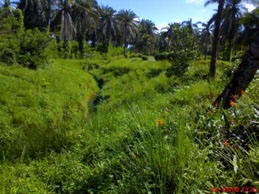 organic palm oil plantation in Mascareignes Island and running a mill to manufacture certified Organic Crude Palm Oil on the East coast of Madagascar. The plantation, 3,000 Ha of land, has 180 km of road; 80 km of drains, and 30 km of river bank. Vetiver, Chrysopogon zizanioides (South India type - essentially sterile) was introduced in 2004 for soil and moisture conservation, and in particularly for drainage protection. Since then STHM has extended the use vetiver for many activities such as river bank protection, slopes stabilization, mulching…… This ideal plant was introduced in 2004 to the plantation by contract with CTHT (Centre Technique Horticole de Tamatave) to reduce erosion, increase soil keep moisture and to stabilize waterway protection. In 2005, STHM started serious work with Vetiver with the intention of substituting previous used costly cement and rock "hard systems" with vetiver's fibrous and massive root system thus saving significant expenditures.
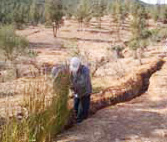
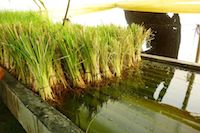 duce large numbers of high quality vetiver plants (slips) for use on complex engineering works, and as a result can significantly increase their incomes and welfare.
 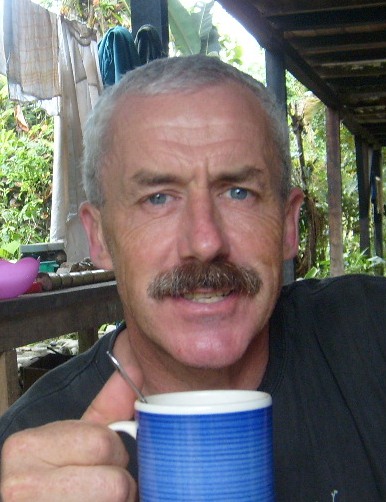 VETIVER IN ECUADOR. Piet sabbe has been using and promoting the application of vetiver for soil and water conservation since 1997. On his own farm the impact of vetiver hedgerows have been significant "In order to have a good showcase for the use of Vetiver, I created vetiver induced terracing on my farm, combining citrus trees and pineapples with Vetiver hedges at an interspace of 6 to 7 meters. Within a couple of years, the effect was clearly visible and measurable: run-off had stopped and the amount of organic matter increased from 0 % to 3 %. The citrus trees produced abundant Tangelo and Lemon. Also, I planted a couple of hectares of pure Vetiver grass for production and business." He has some interesting insights as to the problems of introducing vetiver to small farmers, but more recently has had good success with farmers who practice permaculture and are interested in agro-ecology. Read more about Piet's work