Vetiver’s leaves, roots and the many compounds in them have other uses of real economic and social value. Most lie outside TVNI’s main focus, with two exceptions: handicrafts, which often bring vetiver into a community and open the way for conservation and wastewater uses; and carbon storage, where interest is growing fast.
Handicrafts
Thailand’s Royal Family has long promoted handicrafts, and in the 1990s it led the introduction of fine handicrafts made from vetiver leaves. The Royal Development Projects Board still promotes them and runs low-cost training courses. India, Brazil, China, Grenada, St Vincent and the Grenadines, and Venezuela have followed with excellent programs. In Kerala, India, handicraft groups have helped disadvantaged women turn their lives around. Making handicrafts is often the way a community first meets vetiver, leading on to soil and water conservation and wastewater cleanup.


Photo essay (PDF)Webinar videoDesign guidance: D1 GUIDE-HANDICRAFTS
Thatch
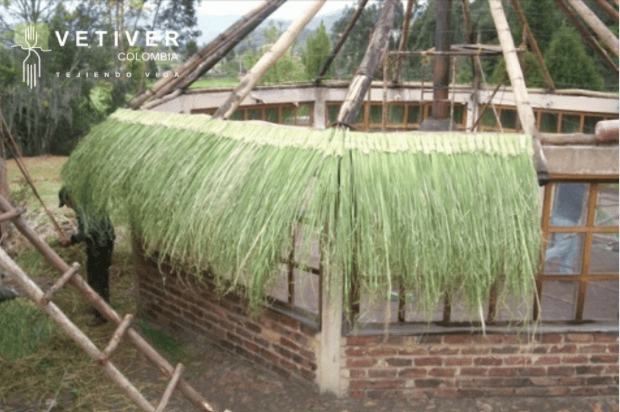
Vetiver makes excellent thatch. Well made, it lasts up to 20 years and keeps a house dry and cool, and as temperatures rise a thatched roof can be more comfortable than metal sheeting. There are two main methods: the Asian style, using panels of vetiver, and the European and African style, using bundles. In Kenya, Christian Makokha has built a successful business offering long-lasting vetiver thatch.

Vetiver oil
For thousands of years vetiver has been prized for the aromatic oil in its roots, and today the oil is found in most perfumes. The main producers are Haiti, India and Indonesia. In Haiti, vetiver for oil is grown on poor hillsides no longer fit for food crops, and digging the roots can leave the soil bare and badly eroded. Growers are being encouraged to plant their harvestable vetiver between permanent conservation hedges. Oil producers can also supply planting material as a by-product, and a few can grow into vetiver service companies.

Design guidance: D2 GUIDE_INTEGRATED VETIVER OIL + SLIP PRODUCTION
Medicinal uses
Vetiver has a long history in traditional medicine, including Ayurveda, where it is known as ushira, and its varied chemistry gives it a range of uses. Its use in aromatherapy is growing, and vetiver ingredients appear in many products. Researchers have studied compounds in vetiver oil that act against the bacteria that cause tuberculosis. TVNI does not give medical advice.
Carbon storage
Vetiver produces a large amount of biomass, both above ground and in its deep root system, but the amount varies with location, soil, management and climate. Two different claims need to be kept apart. Carbon storage is the carbon held in living vetiver for as long as the plant or hedge lasts. Carbon sequestration is the smaller part of that carbon that becomes stable soil organic matter over decades.
Published figures of 20–30 tons of soil organic carbon per hectare a year usually measure biomass production or photosynthesis, not stable long-term soil carbon, and should not be read as sequestration rates. Drawing on Dr. Rattan Lal’s work on tropical grasses, a more defensible figure is about 1 ton of stable soil organic carbon per hectare a year, or roughly 10 tons per hectare over a decade. Vetiver’s standing biomass is a real, if temporary, carbon store, a category the European Union’s carbon farming rules now recognize. TVNI will update this guidance as better long-term data for vetiver become available.
Design guidance: D14 GUIDE_SOIL CARBONDr. Rattan Lal at ICV-7 (video)
Further reading
Guides, reports and videos on handicrafts, thatch, oil, medicinal uses and carbon. Type in the search box to filter by topic, country or author. More papers are in the Document Center and the Conference Papers.