Introduction of Vetiver grass technology (Vetiver System) to protect irrigated, flood prone areas in Central Coastal Vietnam
Final report
Financed by the Small Embassy Program of the Netherlands Embassy,
Coordination:
Dr. Tran Tan Van, of the Research Institute of Geology & Mineral Resources (RIGMR) [email protected]
in collaboration with Elise Pinners (advisor) [email protected]
(from March 2002 to March 2003)
1. Objectives
The long-term objective is to introduce Vetiver Systems (VS) for flood-related hazard mitigation e.g. on riversides, dikes, dams, and dunes.
Short-term objectives, for this one-year project, include demonstration of VS in 2 sites and through these demo’s: convincing key-persons in central Vietnam on opportunities of VS.
2. Partners
Introduction of VS requires collaboration with and between local partners with very different backgrounds/ disciplines.
In Quang Binh there was collaboration with DARD, provincial Departments of Dike Management and Flood Control (DDMFC), the agro-forestry project (IFAD/MOSTE), Le Thuy district forest enterprise, and local farmers affected by the dune sand problem and hired for implementation of works.
In Da Nang there was collaboration with the provincial Department of Dike Management and Flood Control (DDMFC), and local farmers (shrimp pond farmer) and farmer representatives (local road).
3. Expertise
Expertise was provided first of all by the implementers themselves (Dr. Tran Tan Van and Elise Pinners), but also by the coordinator of the Vetiver network in Vietnam, Dr. Phuoc from HCMC University (especially training on multiplication methods, [email protected]) and Dr. Paul Truong from the University in Brisbane, Australia (especially on design, [email protected]).
4. The sites
The sites differ to some extent to the sites mentioned in the proposal (we already mentioned about this in our first report).
- Quang Binh province, Le Thuy district, Hong Thuy and Thanh Thuy villages:
Dune stabilization: foots of sand dunes that are undermined by local streams when there are heavy rains. The bulk of the sand thus transported is deposited in irrigated areas downstream (on the other side of the national highway), which is disastrous for that farming system, of major concern to the farmers. The IFAD/MOSTE project tries to stabilize dunes with Casuarinas and an NGO helped construct sand-dikes (with heavy equipment) to avoid sand deposition on farms. However, the effectiveness of Casuarinas is limited, and from time to time the highly instable and barely vegetated sand-dikes surrender to sand-floods. Besides, the drains crossing the national highway quickly fill up with sand.
For practical reasons the sandy dikes downstream have not been dealt with.
- Da Nang province:
The proposal to stabilize a dam in Hoa Vang commune has not been dealt with because it requires involvement of local authorities concerned with this dam (these authorities appeared to have plans themselves to rehabilitate the dam).
Instead there were three other sites:
a. Shrimp pond farm along Vinh Dien river (Mr. Hien)
b. Road on a landfill along riverbank of Co Co river (Ngu Hanh Son Tourist Area, near Non Nuoc Pagoda), and island in that river
c. Above a riverbank revetment.
5. Main activities
The main activities that were carried out are:
- Meeting in HCMC (Jan. ’02) with Vetiver expert Dr. Paul Truong (discuss demonstration lay-out) and Dr. Phuoc (discuss collaboration, Vetiver network Viet Nam)
- Site selection, preparations for action planning and implementation
- In one field trip (March ‘02), for site 1 (first dune), and 2 a & b, and for the nurseries we did:
- participatory site assessment
- action planning
- VS presentation
- Vetiver multiplication training
- establishment of the demo’s.
- Several monitoring visits (almost monthly, see attached reports)
- Field visit (Feb. ’02) by several partners, to discuss:
- the demos, technical aspects
- other opportunities for VS application in central Vietnam
- how future initiatives can be organized, supported, funded.
Besides, there was some networking and info sharing done with others active in the Vetiver network in Vietnam, and also with potential partners. Thus we met the director of the Dike Department (Mr. Dang Quang Tinh), and people from NDM-P (Dr. Kuberan, Dr. Marshall Silver), and we also kept informed the National Institute of Soils and Fertilizer (Ms. Tran Thi Tam, Mr. Vu Thang).
6. Results
6.1 The demonstrations
In short, there are the following demos:
|
Site |
description |
remarks |
|
Quang Binh, Le Thuy district |
- 3 rows 11 months old on foot of dune slope |
Looks very promising! |
|
- 3-4 rows 4 months old on foot of othr two dune slopes, totalling 1.5 km |
The site that we visited looks very good even though the rows are not watered, now to see whether it will survive next dry season without watering. However, vertical rows absent. |
|
|
Da Nang, Hoa Quy ward |
- shrimp pond bank 11 months old, + adjacent gully |
Looks good, but anticipation of poor soils necessary to avoid gaps/irregular growth. |
|
Da Nang, Hoa Quy ward |
- shrimp pond bank 3 months old + above riverbank revetment |
Serious cattle damage on the pond bank, but well protected along riverbank revetment. |
|
Da Nang, Hoa Xuan ward |
- above riverbank revetment, 3 month old |
Nicely protected slope. |
|
Da Nang, Qua Giang river, Co Man ward |
- above riverbank revetment, 01 month old |
Nicely protected slope. |
|
Da Nang, near Non Nuoc Pagoda |
- along river, road built from dredged soil, 11 months old - along the island |
|
 For more details see the field
reports, available in English and Vietnamese.
For more details see the field
reports, available in English and Vietnamese.
Further, there are larger nurseries established both in Le Thuy district (Quang Binh) and in Da Nang.
6.2 The field visit
The program was tightly scheduled, but generally worked out well. Many more participants than planned for. For program and list of participants see annex. The participants were very varied: institutes (HWRU. RIGMR), NGOs, local authorities, companies.
In the discussions about the different sites most technical questions (e.g. on planting time, planting distance, design, watering, manure, resistance to particular soil conditions, flooding, potential problem as a weed in farms, etc.) were addressed referring to the coming VS presentation, and the reports that were distributed to the participants both in English and Vietnamese.
Sand dune stabilization
It was observed that in both sites the growth was good, and regular, and that other vegetation established well between the rows.
Questions of particular interest were:
- Planting time: more research is needed on the right planting time. Planting in March (just before the hot dry period) is well possible but then watering is needed, which increases costs and risk. These plantings have survived well the summer storms in August through November. Planting in October is also well possible, the plants survived the winter without any watering, but the critical question is: will they be able to survive the hot dry season equally without watering? The expectation is they will, but observations need to continue on this. If they do survive, then planting in October is much more practical (also cheaper).
- Design: planting more rows, above the three already established, is only possible once the plants are big enough to withstand sandflow caused by planting above; however, it seemed hardly necessary to continue planting more rows above, because the major cause for the dune to collapse is the waterflow eroding the foot of the dune; this erosion has now been reduced considerably, according to farmers there is much less sandflow in downstream the site, and thus their problem of sand invading the farm is much reduced.
- Design: some vertical rows could have been added in the 2nd site (can still be done in March).
Most participants found the demonstrations very interesting, and several intended to try themselves; particularly authorities (DARD/DOSTE) from Quang Binh, Quang Tri, Thua Thien-Hue, Quang Nam and Quang Ngai expressed their intentions to set up more demonstrations in dunes. In Quang Binh there are plans to control dune sand erosion in 22.000 ha south of Dong Hoi, to protect about 10 local roads that often fill up with sand.

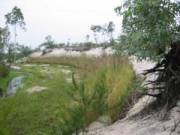
Shrimp pond bank and above riverbank revetment
It was observed that bank growth was irregular due to variable soil. However, growth of other grass in-between the rows was very good.
Questions of particular interest were:
- Soil: shrimp pond banks (or other man-made banks) can be of very variable quality, as we observe in this demo; the extreme soil condition (pH 3) has to be anticipated, by using lime and NPK and/or organic fertilizer, to ensure more regular growth.
- Planting time: if planting is done at the end of a rainy season, will the plants survive dry season without watering? Or if planted at the first rains, will they survive the strong current caused by heavy rains and floods?
- Protection against cattle damage.
- Physical properties: can VS alone (i.e. without other, structural measures) do well on steep banks? Will it withstand high velocity? Will it deal with the slip circle on very high banks as in Q. Ngai?
 Many
participants point out that it is time to try out VS on a real riverbank,
planting down to water level, with vertical rows to slow water velocity.
But should it be done by comparing with (instead of combining, i.e. above)
structural riverbank revetment, as is proposed by Brown&Root in Quang
Ngai, or should VS be tried in places where authorities have no intentions
(and means) to carry out any structural measure? This lead to the
question: what local authority can be in charge of this?
Many
participants point out that it is time to try out VS on a real riverbank,
planting down to water level, with vertical rows to slow water velocity.
But should it be done by comparing with (instead of combining, i.e. above)
structural riverbank revetment, as is proposed by Brown&Root in Quang
Ngai, or should VS be tried in places where authorities have no intentions
(and means) to carry out any structural measure? This lead to the
question: what local authority can be in charge of this?
The adjacent gully plugging looked also good (to reduce damage from flow of field water to the river).
Most participants found the demonstrations very interesting, and several intended to try VS themselves for:
Ha Tinh: - roadside stabilization
Quang Binh: - dune sand fixation on dune slopes and along sanded roads
- on-farm slope erosion control
Thua Thien-Hue: - Ho Chi Minh highway and river bank protection
Da Nang: - roadside stabilization
Quang Ngai: - on estuary dykes (Brown&Root)
- on-farm erosion control combining Vetiver with Guinea grass (for fodder)
Quang Tri: - sand dune fixation.
Discussion of future opportunities to apply VS, and how to organize it.
There were practical questions, like:
- where to obtain Vetiver planting material, for what price
- the need to have a complete handbook on all applications (in Vietnamese), with technical, design instructions
- where to obtain funding for establishment of VS demo’s (& technical support) and research.
For these questions the suggestions all went in the direction of: knowledge networking between all those concerned, voluntary exchange of technical expertise, materials, sources of funding, planting materials.
And there was the question on how to organize future activities. The project has finished, local partners are encouraged to take initiative and try things, but at this stage there remains a need for:
- technical support from outside (especially help with design, some training and follow-up)
- active exchange of experience between the provinces.
For example, if riverbanks need protection, whose problem is it? If DDMFC has to concentrate on priority sites, using large budgets for structural measures, and not always having the interest or capacity to develop alternative methods for sites of less priority, who will take on this task? The Department of Resources and Environment (department of lands? Environment?)? DARD? The extension centre/stations?
Quang Binh authorities propose a workshop with experts (incl. VS experts but also others), local authorities, donors and farmers.
The draft project proposal (only English version) was distributed to a few participants.
7. Financial report
The money has generally been spent according to the revised budget (in US$):
|
Budget-lines |
Original budget |
Revised budget (August/2002) |
Expenditure |
|
|
1 |
Meeting in HCMC with Paul Truong & Phuoc |
700 |
725 |
741.92 |
|
2 |
Participatory land-use assessment and action planning (2 sites) |
1225 |
280 |
279.47 |
|
3.1 |
a. Vetiver multiplication training and b. Establishment of demonstration |
2200 |
2025 |
2028.53 |
|
3.2 |
Quang Binh, maintenance of demo, nursery and mass planting of 1.5 km |
5400 |
2980 |
2732.45 |
|
3.3 |
Da Nang, maintenance of demo, nursery and mass planting of 2 km |
2700 |
2130 |
2903.97 |
|
4.1 |
Monitoring |
685 |
1780 |
1600 |
|
4.2 |
Stationary |
265 |
3300 |
1979.86 |
|
5 |
Exchange visit |
1780 |
1780 |
2585.38 |
|
6 |
Others |
45 |
0 |
141.13 |
|
7 |
TOTAL |
15,000 |
15,000 |
14,993.31 |